Thứ Sáu, 2 tháng 1, 2015

About Huong Hai Ha Long

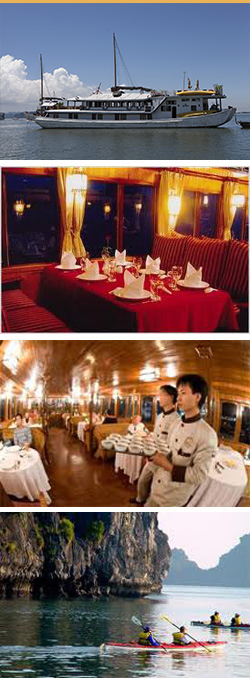
For more than 10 years in serving and hosting international guests on the tranquil waters of the bay, we do set a well-known, leading and stable standard of the best quality service for Ha Long Bay cruise trip from mid-range to high-range customer. The first and biggest company to offer overnight cruises on the bay,
Huong Hai understands customers’ desire and we built the first  traditional style wooden boat with deluxe deluxe cabins and facilities. As a result, nearly half of 1 million people have joined Huong Hai Junks on magical, enlightening journeys through Ha Long Bay,  Huong Hai cruise.

Beside the wooden traditional boat fleet with 6 boats named Huong Hai Junks, Huong Hai Ha Long proudly to grand open new luxury cruise named Huong Hai Sealife Cruises. The new boat inherits the experience of cruise service over the years and set a new standard of luxury cruising.

Grand Halong hotel on Halong bay Travelling Tour

About Huong Hai Ha Long

The first responsibility is to passengers and partners. Its products and services must always be of the best quality in 3-star standard. And bookings must be promptly attended too. Its trade channels buyers must make a fair profit.

Lost in the maze of Halong Bay caves


The second responsibility is to those who work with us, they must have a sense of security in their jobs. Wages must be fair and adequate. Management is just, hours reasonable and working condition nurturing. Captains & Supervisors are qualified and fair minded. Each crew member must be considered an individual, standing on his own dignity & merit.

The third responsibility is to Management. Our executive must be person of talent, education, experience and ability. They must possess common sense and full understanding.
The fourth responsibility is to the local communities and authorities. We will support environmental friendly project and local charity. We promote civic improvements, health, education, invest back into the local communities and make them part of the development of responsible Tourism.

Thứ Tư, 24 tháng 12, 2014

Christmas in Vietnam

Christmas is one of the four most important festivals of the Vietnamese year, including the birthday of Buddha, the New Year and the Mid-autumn Festival. Although the Christians observed the religious rituals of Christmas.

Traditional Vietnamese religions are Buddhism and the Chinese philosophies of Taoism and Confucianism. However, during French rule, many people became Christians, that occupy 8 to 10 percent of whose population. This is because the Vietnamese are a fun-loving, sociable people and the various Vietnam festivals and events are actually occasions for them to a gala time, all together. Christmas in Vietnam is a grand party. Tours to Vietnam

History Of Christmas In Vietnam

Christmas in Vietnam has had a tumultuous history. The Catholics are a minority in Vietnam but they used to celebrate Christmas in Vietnam quite in peace right from the days of the French rule. That is until the Communists took over political power in 1975. The church-state relations soured during that time and the Catholics were relegated to celebrating Jesus’s birthday in privacy.

Hoi an, a peaceful meeting place


Since the end of the Vietnam War in 1975, church-state relations have not always been smooth. However, they have been improving since the introduction of economic reforms in the late 1980s. Liberalist policies adopted since the 1980s saw Vietnam warming up to western influences and ideals and Christmas in Vietnam came back triumphantly. Now Christmas is one of the major festivals in Vietnam, celebrated with much fanfare by all religious communities. top 3 must see tourist attractions in Can Tho
Christmas in Vietnam

Phat Diem Cathedral in Ninh Binh Province is considered the spiritual home for the seven million Catholics who live in Vietnam, a predominantly Buddhist nation. Hundreds of Catholics gather for Christmas Eve Mass in the northern city of Phat Diem. Children staged a nativity play to celebrate the birth of Jesus Christ - or Kito, as he is known in Vietnamese -- in front of the city's cathedral, built in 1891.

Christmas In Vietnam

Christmas in Vietnam is a huge event, especially in Ho Chi Minh City, Vietnam and the Vietnamese Christmas celebrations here are like any other city in the western world. The Christians in Vietnam attend a Midnight mass on Christmas Eve and return home to a sumptuous Christmas dinner. The Christmas dinner usually consists of chicken soup while wealthier people eat turkey and Christmas pudding.Christmas tree at Fortuna Hotel (Hanoi)
Christmas tree at Fortuna Hotel (Hanoi)


On Christmas Eve, Vietnamese people in Hanoi and Ho Chi Minh City, especially young people, like to go into the city centre, where there is a Catholic Cathedral. The streets are crowded with people on Christmas Eve and in the city centre cars are not allowed for the night.

People celebrate by throwing confetti, taking pictures and enjoying the Christmas decorations and lights of big hotels and department stores. Lots of cafes and restaurants are open for people to enjoy a snack!

Vietnam used to be part of the French Empire and there are still French influences in the Christmas traditions. Many Catholic churches have a big nativity crib scene or 'creche' with nearly life size statues of Mary, Joesph, baby Jesus, the shepherds and animals. In some areas of Ho Chi Minh City, usually in Catholic parishes, people have big crib scenes in front of their houses and decorate the whole street, turning it into a Christmas area! These are popular for people to visit and look at the scenes.

Also like in France, the special Christmas Eve meal is called 'reveillon' and has a 'bûche de Noël' (a chocolate cake in the shape of a log) for desert. Vietnamese people like to give presents of food and at Christmas a bûche de Noël is a popular gift. Other Christmas presents are not very common, although some young people like to exchange Christmas cards.

The Yuletide spirit of giving and sharing has been embraced with an earnest by the Vietnamese. Generous as they are, the Vietnamese give out gifts and presents in plenty during the Christmas celebrations in Vietnam. However, the children are more keen to have their stockings and shoes stuffed in with goodies from Santa’s bulging sack. The European customs of Santa Claus and the Christmas tree were popular and children would leave their shoes out on Christmas Eve.

Merry Christmas in Vietnamese is “Chúc Mừng Giáng Sinh”!

Thứ Tư, 17 tháng 12, 2014

Kate Festival

Time: From the 30th day of the 6th month to 2nd day of the 7th month according to Cham calendar (around at the end of September and the beginning of October according to solar calendar).
Place: Po Inu Nagar Temple, Po Klong Garai Tower, Po Rome Tower (Ninh Thuan Province)
Objects of worship: Goddess Po Inu Nagar, King Po Klong Garai and King Po Rome.
Characteristics: Ritual of the Cham people. Mekong river tours

Kate Festival is the most unique festival of the Cham people. It associates with ancient towers where values of Cham culture are stored and other cultural aspects such as offerings, costumes, music instruments and hymns praising kings who made great service to the Champa Kingdom and Cham people. The festival is also an occasion for the participants to enjoy traditional arts performances of Cham people such as Apsara dance, Ginang and Paranung drum-beat, Saranai trump...
Kate Festival

The first day is for the ritual of receiving Goddess Po Inu Nagar's costume at Po Inu Nagar Temple in Huu Duc Hamlet, Phuoc Huu Commune, Ninh Phuoc District. Legend has it that Ra Glai people are Cham people's brother. Whenever upheavals come, kings of Cham people leave their country to seek refuge and commit their royal costumes to the Ra Glai people. Therefore, at the Kate Festival every year, the Cham people have to do a ritual to welcome and receive the costumes from the Ra Glai people. In the afternoon, the Ra Glai people in Tra No Hamlet, Phuoc Ha Commune, Thuan Nam District, Ninh Thuan Province bring costume of Goddess Po Inu Nagar to Cham people. The ritual of receiving Goddess Po Inu Nagar's costume is held first because Cham people consider Po Inu Nagar as ancestress of the Cham people. She taught local people to grow rice, plant cotton, weave clothing...

The second day (main festival day) is for Kate Festival at Po Inu Nagar Temple, Po Klong Garai Tower and Po Rome Tower. The festival takes place in three areas at the same time. In the early morning, the Ra Glai people in Phuoc Dong Hamlet, Phuoc Hau Commune, Ninh Phuoc District arrive at Po Klong Garai Tower in Do Vinh Ward, Phan Rang - Thap Cham City to hand King Po Klong Garai's costume over to the Cham people. When the procession arrives at the tower, a group of dancers will perform a welcome dance in front of the tower. After that, the ritual to ask permission of God Siva to open tower's door is held. The offerings include wine, egg, betel and areca, water mixed with aloe wood. The following rituals are bath and wear for the statue of King Po Klong Garai. Finally, a man (Kadhar) sings hymns to invite over 20 gods to attend great ritual. At the same time, participants pray the gods for health, happiness, abundant crop... The great ritual ends with a dance of ba bong (Muk Pay'u).

The similar rituals are also held at Po Inu Nagar Temple and Po Rome Tower in Hau Sanh Hamlet, Phuoc Huu Commune, Ninh Phuoc District.

The third day is for Kate Festival at Cham villages. Each Cham village worships its own God. In the morning, the ritual of worshipping God is held to pray for health, happiness, abundant crop... The offerings include 2 chickens, 5 trays of food, banh tet (cylindrical glutinous rice cake), fruits...  During the festival, many cultural activities and games are held, such as competitions of weaving, carrying water jar on one's head, football, singing.le bring breakfast to monks and listen to the sermon. At noon, they burn the lamps, offer sacrifice gifts and bring fragrant water to bathe Buddha statues. After the ceremony at the temple, the monks go to the grave to pray for the souls of those who died. Then they go home and do Buddha bathing ceremony at their own home in order to receive forgiveness for the mistakes in the previous year.

Thứ Sáu, 5 tháng 12, 2014

About Mekong Delta

Your trip to Sapa might be incomplete if you miss a trek to cultural villages which have attracted a lot of tourists nationwide by theirs unspoiled landscapes and traditional customs of ethnic minorities living here. Among many villages, ones introduced below are quite famous and worth paying a visit North Vietnam tours

Discover the authenic Mekong delta and cruise the river in comfort !

The Mekong Delta (Vietnamese: đồng bằng sông Cửu Long “Nine Dragon river delta”) is the region in southwestern Vietnam where the Mekong River approaches and empties into the sea through a network of distributaries. The Mekong delta tours region encompasses a large portion of southeastern Vietnam of 39,000 square kilometres (15,000 sq mi). The size of the area covered by water depends on the season.
As all deltas, it receives the bounty of the siltation from the upper Mekong, and as such is a very rich and lush area, covered with rice fields. It produces about half of the total of Vietnam's agricultural output (in fact the delta produces more rice than Korea and Japan altogether), and is the place for timeless sceneries of farmers planting or harvesting rice.
About Mekong Delta
About Mekong Delta


The Mekong splits in Cambodia into two main rivers, the Bassac (Hậu Giang) and the First river (Tiền Giang), then in Vietnam into a more complex system, creating a maze of small canals, rivers and arroyos interspersed with villages and floating markets.

Life in the Mekong Delta revolves much around the river, and all the villages are often accessible by river rather than by road.

The most renowned places in the Mekong Delta are Mỹ Tho and Caí Bè near Ho Chi Minh City, then, more to the heart of the region, Vĩnh Long, Sa Đéc, and Cần Thơ, from where it is possible to reach the remotest confines of the delta, South towards the mangroves and the East-sea, North towards Châu Đốc, or West towards the island of Phú Quốc.

Climate change concerns

Being a low-lying coastal region, the Mekong Delta is particularly susceptible to floods resulting from rises in sea level due to climate change. The Climate Change Research Institute at Can Tho University, in studying the possible consequences of climate change, has predicted that, besides suffering from drought brought on by seasonal decrease in rainfall, many provinces in the Mekong Delta will be flooded by the year 2030. The most serious cases are predicted to be the provinces of Ben Tre and Long An, of which 51% and 49%, respectively, are expected to be flooded if sea levels rise by 1 meter.

Economy

The region is famous as a large rice growing area. It produces about half of the total of Vietnam's rice output. Vietnam is the second largest exporter of rice globally after Thailand. In fact, the delta produces more rice than Korea and Japan altogether.

Additionally, the region is home to large aquacultural industry of basa fish, Tra catfish and shrimp, much of which is exported.

The Mekong Delta has recently been dubbed as a 'biological treasure trove'. Over 1,000 new species have been discovered in previously unexplored areas of Mekong Delta, including a species of rat thought to be extinct

Culture

Life in the Mekong Delta revolves much around the river, and many of the villages are often accessible by rivers and canals rather than by road.

The region is home to "cai luong", a form of Vietnamese folk opera.  
Thứ Tư, 26 tháng 11, 2014

Fruit festival in Tien Giang

Tien Giang Province in the Mekong river cruise hosted the first ever national fruit festival in My Tho city from April 19 to 24

Tran Hoa Huy, a member of the organization board, said the festival would welcome over 100,000 guests and tourists. There are 350 rooms available for accommodation in My Tho City and in nearby provinces such as Long An, Ben Tre and HCMC. The recently opened Trung Luong Expressway makes My Tho City only a 40 minute drive from HCMC. Visit South Vietnam tours

With more than 700 stalls, the event displayed 2,000 tons of fruit from 24 provinces, including the well-known Hoa Loc mangoes, Lo Ren Vinh Kim star-apples, Chin Hoa durians and Hung Yen longans. Also, the festival features agricultural products and plant exhibitions, food fairs, firework displays and festivities at Cai Be floating market. Several national records are expected to be set during the festival too, including the largest map of Vietnam and the longest dragon made entirely of fruit.
Fruit festival in Tien Giang
Fruit festival in Tien Giang 


There would also be an awards ceremony to honor farmers, scientists and enterprises who have contributed to research and planting processes to deliver high-quality Vietnamese fruit to both local and global markets.VAM HO BIRD SANCTUARY

Nguyen Minh Chau, head of the Southern Fruit Research Institute, said the country, and especially the Mekong Delta, boasts a wide variety of good fruit owing to favorable climate and soil.

Vietnam has a total of 776,000 hectares under fruit cultivation and can increase competitiveness compared to leading exporters Thailand and China if it invests more into seedling research, modern techniques and brand building.

The Fruit Festival will host a series of seminars on developing trademarks for Vietnamese fruit on the global market and measures to create and strengthen links between scientists, farmers, processors and local authorities to increase value.

This festival is set to become a five-yearly event.

Thứ Ba, 18 tháng 11, 2014

Where To Go In Vietnam: North Or South?

Many who visit Vietnam say it’s one of the most colourful countries in all of Southeast Asia. And they might argue that this is due, in part, to the distinct differences in culture and climate that exist between the north and the south of this spectacular nation.

Whether you decide to spend your time in the north or south may depend on what time of year it is. The north tends to experience cool, damp winters and hot dry summers, whereas the south has more of a consistent tropical climate that is broken by a rainy season between May and November.

The North Vietnam tours – When & Where

An ideal time to visit North Vietnam is between September and December when it isn’t too humid and not yet cold. That said, capital Hanoi tends to be temperate all year round.

Halong Bay
UNESCO listed Halong Bay tours as a World Heritage site due to its outstanding natural beauty and unique biological importance. Visitors who come to Halong Bay encounter formations of limestone islands that jut out of the water and are covered by jungle vegetation. It’s a dramatic sight and looks almost unworldly, as if the islands are floating on the water! Many of the rocks are hollow, with huge caves clustered inside them, and kayaking tours are one of the most popular ways to explore them.

Hanoi
As the cosmopolitan capital of Vietnam, many visitors fly into Hanoi and use it as the starting point to explore the country’s northern regions. Boasting thousands of years of rich history, Hanoi is the place to come to see ancient Buddhist temples, national museums and get a taste of Vietnam’s long and varied traditions. The Old Quarter is well worth a visit. Little-changed since the days of ancient Hanoi, the streets are named after the various trades and retail goods once sold on them.

Sa Pa
If small traditional towns, spectacular mountain views and rice terraces are what draw you to Vietnam, then head to Sa Pa. Buses depart from Hanoi, but you can expect an eight-hour journey. It’s worth it though, as Sa Pa feels like a step back in time to a more traditional Vietnam. The locals are friendly and visitors can trek by verdant rice paddies, dense forests and spectacular waterfalls.

The South Vietnam Tours – When & Where
Visit between December and April during dry season, when the temperature tends to be steadily in the high twenties (Celsius). Having said that, downpours during the rainy season from May to November tend to be short-lived and rarely put travellers off.
Ho Chi Minh City
Ho Chi Minh City is a bustling and at times chaotic place. It’s everything you would imagine from Vietnam’s largest city, only at 10 times the speed! As you fly in, you can see streets of scooters whizzing in and out traffic – so many in fact that streams of red and white lights can be seen from the plane. It’s a wild and wonderful place, with great shopping, a huge variety of dining options and fantastic nightlife. Many visitors come here for a few days of living it up, before heading to a quieter beach town to relax.

Da Lat
If you’re in Vietnam during the hotter months, Da Lat is a great option for a few days of cooler weather. It’s quite unlike anywhere else in Vietnam and is often referred to as ‘the city of eternal spring’. It’s not just the pleasant climate that draws in the crowds either; Dalat is surrounded by rolling countryside, huge waterfalls and forests and was once the playground for the elite of French colonial society.

Get away and relax in Da Lat
Nha Trang
Nha Trang is perhaps the most renowned beach resort town in the south of Vietnam. Popular with expats and international tourists alike, it’s more urban than other beach resorts in Vietnam, and for that reason is a sensible place to head for those who enjoy their creature comforts. You can also head here if you’d like to try a bit of scuba diving too!
Where To Go In Vietnam: North Or South?


Mekong Delta tours
Covering the southwestern portion of Vietnam, the expansive Mekong Delta is simply mind-blowing.  Boat trips down the Mekong River propel you straight into old-world Vietnam, and homestays in the area are becoming a popular option for those who want to really feel like they’re getting away from it all.

Thứ Năm, 6 tháng 11, 2014

Tips for safe dining of seafood in Halong

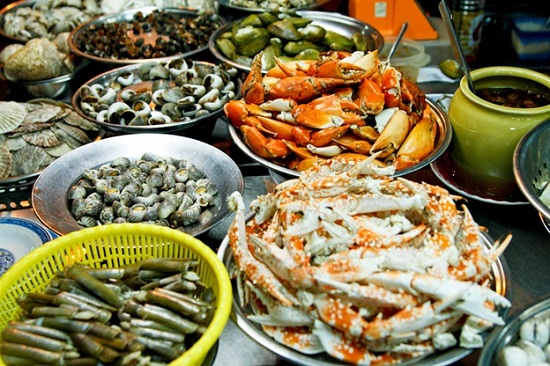
Halong, known as the world heritage city with thousands of caves and grottos, is also famous for its abundance of nutritious and delicious varieties of seafood like crab, prawn, fish, or sea-snail. Gourmets who come to Halong can hardy resist the taste of fresh seafood without the worry of gaining weight. However, there is always risk of food poisoning hidden in seafood. Below are some safety tips to avoid trouble with dining in Halong bay tours.

1. Avoid eating raw seafood in general

Raw seafood or unprocessed seafood may contain the Vibrio parahaemolyticus bacteria which is harmful for the digestive system. Moreover, the bacteria can live under high temperature (more than 80oC). Although sushi and sashimi is very tempting, try not to eat too much, esepecially from the dubious dining places. Fresh seafood in Halong Bay

2. Never eat raw crab
Tips for safe dining of seafood in Halong

Inside unprocessed Ha Long’s crab is a very dangerous parasitic bacteria named lung fluke that may mess up your respiratory system with symptoms like lead to severe cough, coughing up blood, or even cerebral paralysis. It is highly recommended that crabs have to be fully cooked for at least 20-30 minutes. Travel to Halong with Vietnam tours

3. Seafood shopping tips

Buying your own seafood in a market to bring back to your hotel and ask the chefs to cook for you is a very enjoyable experience. However, remember to choose ones which are still alive and fresh, because dead sea-animals, especially one that has shells, contain much higher level of bacteria or poisons.

4. Avoid drinking excessive beer while eating seafood

Scientists say drinking beer while eating seafood increases the probability of having gout or arthritis disease. Therefore, it is recommended that you limit your alcohol consumption when being served seafood.

5. Avoid having fruits/tea after having seafood

The reason is that the acid inside sour fruits may negatively affect the process of absorbing protein from seafood into your body. Besides, tannin from fruits may react with calcium and protein from seafood to stimulate your digestive system that leads to stomach-ache and vomiting. Same thing happens if you drink tea after a seafood meal.